Table of Content
1. INTRODUCTION
1.1 General
This document is intended to provide guidance for the reporting and follow up of ISM deficiencies in the scope of a PSC inspection. In the application of the ISM Code during inspections, the following should be observed:
ISM verification is the responsibility of the flag State and the Company and does not fall under the scope of port State control.
The SMS documentation may be in a language not understood by the PSCO. It is not a harmonised procedure if the PSCO looks at the SMS documentation on only those ships where they can understand the language.
1.2 Application
The ISM Code applies to all passenger vessels and to cargo ships, regardless of the date of construction, and self-propelled MODUs of 500 GT and upwards, engaged on international voyages.
For establishing the applicability of SOLAS Chapter IX and the ISM Code; “Gross Tonnage” means the gross tonnage of the ship as determined under the provisions of the International Convention on the Tonnage Measurement of Ships, 1969 and is stated on the International Tonnage Certificate (1969) of the ship.
The ISM Code does not apply to government-operated ships used for non-commercial purposes.
2. INSPECTION OF SHIP
2.1 ISM documentation
During a PSC inspection, the PSCO should verify that the ship carries:
- a valid copy of the ISM Company’s Document of Compliance (DoC), including endorsements as appropriate. The copy is not required to be authenticated or certified.
- a valid Safety Management Certificate (SMC), including endorsements as appropriate.
The SMC is not valid unless the ISM Company holds a valid DoC for that ship type. The ship type in the SMC should be included in the DoC and the Company’s particulars should be the same on both the DoC and the SMC.
2.2 The ISM Aspect
The PSCO should consider the ISM aspect:
- If deficiencies are found (see also paragraph 3), and
- If the ship is required to carry an SMC
The PSCO should not consider the ISM aspect:
- If the ship holds an Interim SMC
If a deficiency is found on an initial inspection and is considered to be a failure of the effectiveness or implementation of the ISM Code and considered “ISM Related” then this is clear grounds for a More Detailed Inspection and the inspection type should be changed accordingly.
In addition to the clear grounds as outlined in the base instruction[1], PSCOs should consider non-rectified or repeated deficiencies from a previous inspection.
3. REPORTING OF ISM DEFICIENCIES
3.1 Deficiency Assessment
Any deficiencies found during the inspection should be, individually or collectively considered by the PSCO, using their professional judgement, to indicate that either:
- these do not indicate a failure, or lack of effectiveness, of the implementation of the ISM Code; or
- there is a failure, or lack of effectiveness, of the implementation of the ISM Code.
3.2 ISM Related Deficiencies
If there are deficiencies reported:
- Which, whether detainable or non-detainable, do not indicate a failure, or lack of effectiveness, of the implementation of the ISM Code. These deficiencies will not be marked as ISM-related and thus also no ISM deficiency (code 15150) should be reported in the PSC inspection report.
-
of which at least one non-detainable deficiency was marked as ISM related and thus indicates a failure, or lack of effectiveness, of the implementation of the ISM Code:
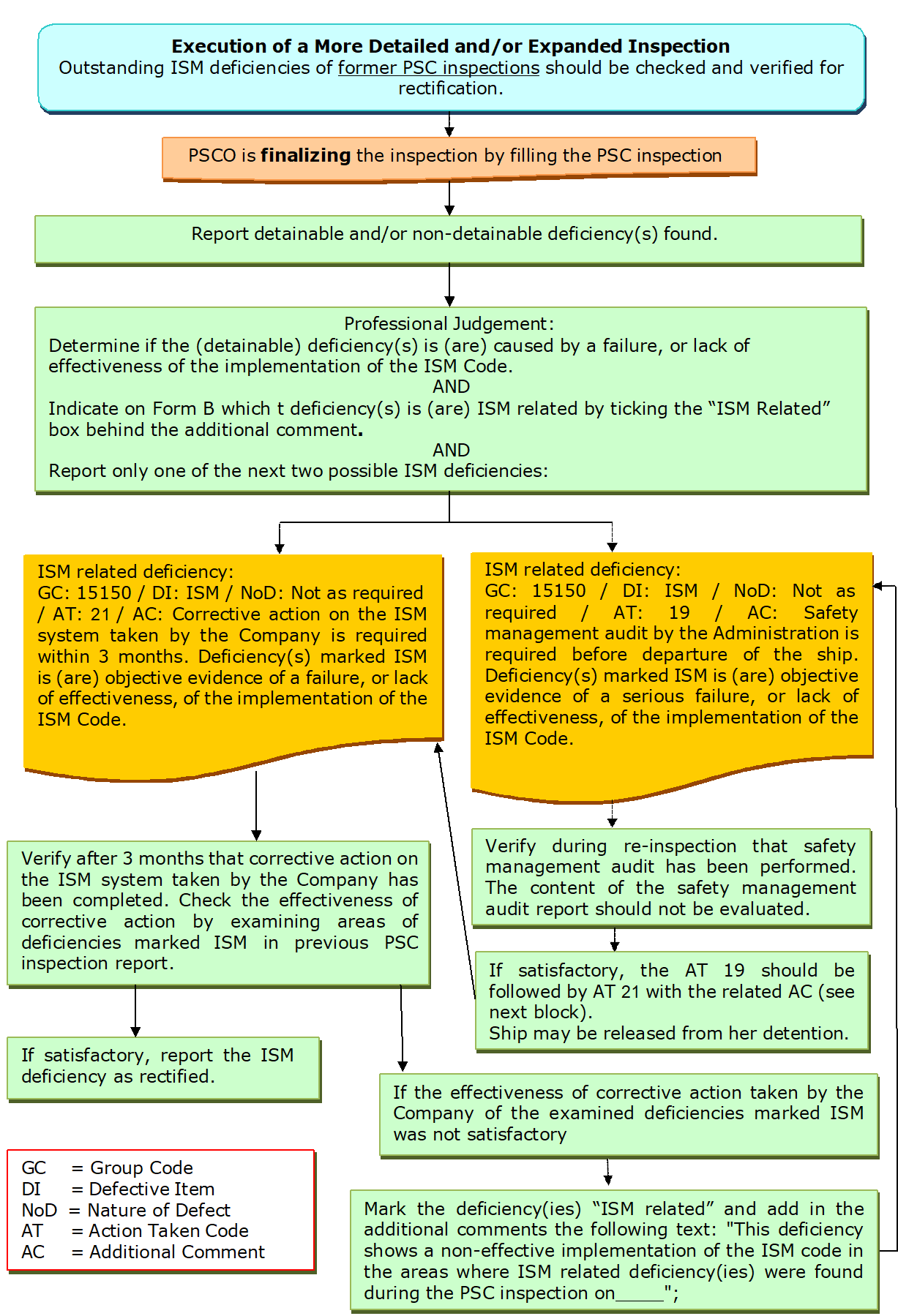
- the PSCO should report an ISM deficiency (code 15150) in the PSC inspection report with the requirement of corrective action within 3 months, and
- the inspection (if Initial) should move to a More Detailed Inspection.
- Which individually do not lead to detention but collectively (due to the combination of deficiencies of a less serious nature as described under Section 3.4 of the Paris MoU Memorandum and under the Guidance on action taken codes) indicate a serious failure or lack of effectiveness of the implementation of the ISM code and warrant the detention of the ship, all of the deficiencies falling within the scope should be marked as ISM related. Additionally, the PSCO should report an ISM deficiency (code 15150) marked as “ground for detention” in the PSC inspection report with the requirement that a safety management audit has to be carried out by the Administration before the ship may be released from detention.
- of which at least one detainable deficiency was marked as ISM related and thus indicates a serious failure, or lack of effectiveness, of the implementation of the ISM Code, the PSCO should report an ISM deficiency (code 15150) marked as “ground for detention” in the PSC inspection report with the requirement that a safety management audit has to be carried out by the Administration before the ship may be released from detention.
Where the PSCO has considered the deficiencies found, and concluded that these provide objective evidence of a (serious) failure, or lack of effectiveness, of the implementation of the ISM Code, one ISM deficiency should be reported in the PSC inspection report. The Convention reference for the Code 15150 deficiency is SOLAS Chapter IX, Regulation 3. There is no need to link the ISM deficiency further to a relevant paragraph of the ISM Code, as in cumulative cases there may be several references.
The deficiencies, which are ISM related, should be indicated in the PSC inspection report by ticking the “ISM related” box behind the additional comment of the particular deficiencies.
| ISM (code 15150) | Action taken | Standard free text |
|---|---|---|
| Grounds for Detention | Safety management audit by the Administration is required before departure of the ship (AT code 19)[2]. | Safety management audit by the Administration is required before departure of the ship. Deficiency(ies) marked “ISM related” is (are) objective evidence of a serious failure, or lack of effectiveness, of implementation of the ISM Code. |
| Not Grounds for Detention | Corrective action taken on the ISM system by the Company is required within 3 months (AT code 21)[3]. | Corrective action taken on the safety management system by the Company is required within 3 months. Deficiency(ies) marked “ISM related” is (are) objective evidence of a failure, or lack of effectiveness, of the implementation of the ISM Code. The ship will be eligible for inspection after 3 months from the date of the last visit of the inspection. |
4. FOLLOW UP
4.1 ISM Company
The follow-up by the Company of the required corrective action taken on the safety management system (within 3 months) or safety management audit (before departure) should not be limited to only the rectification of the deficiencies found.
4.2 Releasing Ship Detained on ISM (19 → 21)
When releasing a ship detained on ISM (and other deficiencies), the action taken code should change from 19 → 21. Note that the marker “Ground for detention” should remain in the final detention report and not be removed in the database.
4.3 Subsequent Inspection (21 → 10 or 21 → 19)
The PSCO will verify the effectiveness of any corrective action by examining deficiencies of the previous PSC inspection report which led to the issuance of the ISM deficiency (code 15150) if the due date for rectification has passed. Although an ISM deficiency (code 15150) can only be raised once during an inspection, a ship can have multiple ISM deficiencies raised during different inspections. These ISM deficiencies can be closed out at the same subsequent inspection, provided that the due dates for rectification have passed and deficiencies found rectified without recurrence.
At a subsequent inspection, at least after 3 months, the PSCO should be satisfied with the effective implementation of the ISM Code in the areas where all previous deficiencies, marked “ISM related”, were found.
If upon examination of the deficiencies related to an action taken code 21 are found not satisfactory then the action taken code 21 will be raised to 19 and the vessel will be detained.
During the subsequent inspection the PSCOs should be guided by the “deficiency areas” included in the “THETIS deficiency matrix”; E.g.: in the event that multiple ISM related deficiencies have been described in the same deficiency area and one of these has not been dealt with, this should not automatically lead to a detention of the ship. The PSCOs should use their professional judgement to assess whether the examination was satisfactory.
In case not satisfactory, the PSCO should apply the following procedure:
- Record one or more deficiencies, detainable or not, in the same area(s) which led to the issuance of the ISM deficiency;
- Mark the deficiency(ies) “ISM related” and add in the additional comments the following text: "This deficiency shows a non-effective implementation of the ISM code in the areas where ISM related deficiency(ies) were found during the PSC inspection on_____";
- Record a new ISM deficiency (code 15150) as "ground for detention" with action taken code 19.
- Close the outstanding (code 15150) deficiency from the previous inspection when the ship is re-inspected for the release from the detention.
4.4 Deficiencies
4.4.1 Deficiencies in Documentation
The PSCO should consider the ISM aspect as per any deficiency related to ISM documentation.
4.4.2 Deficiencies Not Warranting Detention
Minor typing errors in the DoC or the SMC should be reported in the PSC inspection report as a deficiency under their respective codes.
4.4.3 Deficiencies Warranting Detention
- There is no SMC and/or copy of the DoC on board the ship.
-
There is no valid SMC on board;
- The SMC issued to a ship should have a period of validity not exceeding 5 years from the date of expiry of the existing SMC. The validity of the SMC should be subject to at least one intermediate verification. If only one intermediate verification is to be carried out during the 5 year validity period of the SMC, it should take place between the second and third anniversary dates (counted back from the expiry date) of the SMC.
- The SMC intermediate verification is overdue.
-
The SMC is expired and there is no objective evidence of an extension issued by the Administration;
-
Where the SMC has been withdrawn by the Administration:
- the port State should ensure that the ship does not operate (such steps may include detention or other action) until the SMC[4] is re-issued.
- as a result of detainable deficiency(ies), an Interim SMC should not be issued. The new SMC should have the same expiry date, as the withdrawn SMC.
-
Where the SMC has been withdrawn by the Administration:
-
The DoC is expired or withdrawn;
- The port State should ensure that the ship does not operate (such steps may include detention or other action) until the DoC has been re-issued.
- The ship type as indicated on the SMC is not listed on the DoC.
-
Evidence of the DoC annual verification is not available on board;
- Upon request of the port State, the Administration should provide relevant information available to the Administration concerning the current validity of the DoC presented by the ship.
- The certificate number on the copy of the DoC and that on the endorsement pages are not the same.
- The Company name, the Company address or the issuing Government authority on the DoC is not the same as on the SMC.
[2] The Action Taken code 19 is used only in relation to ISM deficiencies and is displayed in THETIS as “17” and “to be rectified before departure”.
[3] The Action Taken code 21 is displayed in THETIS as “21” and “Corrective action taken on the safety management system by the Company is required within 3 months”.
[4] Refer to point 3.10 of ISM Code for cases of SMC with a period of validity exceeding 5 years.